
Human rights for the AI generation.
The way you walk is enough
Most of the privacy conversation in 2020 was still about data - who holds it, who consented to it, who gets to delete it. I'd become convinced that argument was already a generation out of date.
Here's the uncomfortable bit. A machine doesn't need your name, your email or your face to work out who you are and what you're likely to do. The way you walk will do it. So will the shape of your ear, or the pattern of a hundred small things you'd never think to hide. And almost every privacy law we have - GDPR, CCPA, the lot - was written to protect your data. None of it has much to say about a system that reaches its conclusions from things that were never your data in the first place.
That leaves a strange and growing gap. A company can know more about you than you know about yourself, and act on it: what you're shown, what you're charged, whether you're flagged, all while you have no idea the judgment was ever made, let alone any way to correct it when it's wrong. And these systems get it wrong unevenly. The best facial recognition of the day still misread Black faces several times more often than white ones, so the price of a bad guess always seemed to land on the people least able to argue back.
The popular answer to all of this was more privacy. Lock it down, anonymise, encrypt, hide. But push that to its conclusion and you get a quiet problem: if everything's hidden, nobody can see when the machine got it wrong. The mistake doesn't go away. It just becomes invisible, and the discrimination with it.
So we made the opposite bet. Not more secrecy - more sight. Show people the observations being made about them. Let organisations be seen to learn from their mistakes instead of burying them. Do that, and you get the one thing privacy on its own can never hand you: trust you can actually check. That was FORTYEIGHT.ai, sitting where artificial intelligence, human rights and consent meet.
Putting the person back in the room
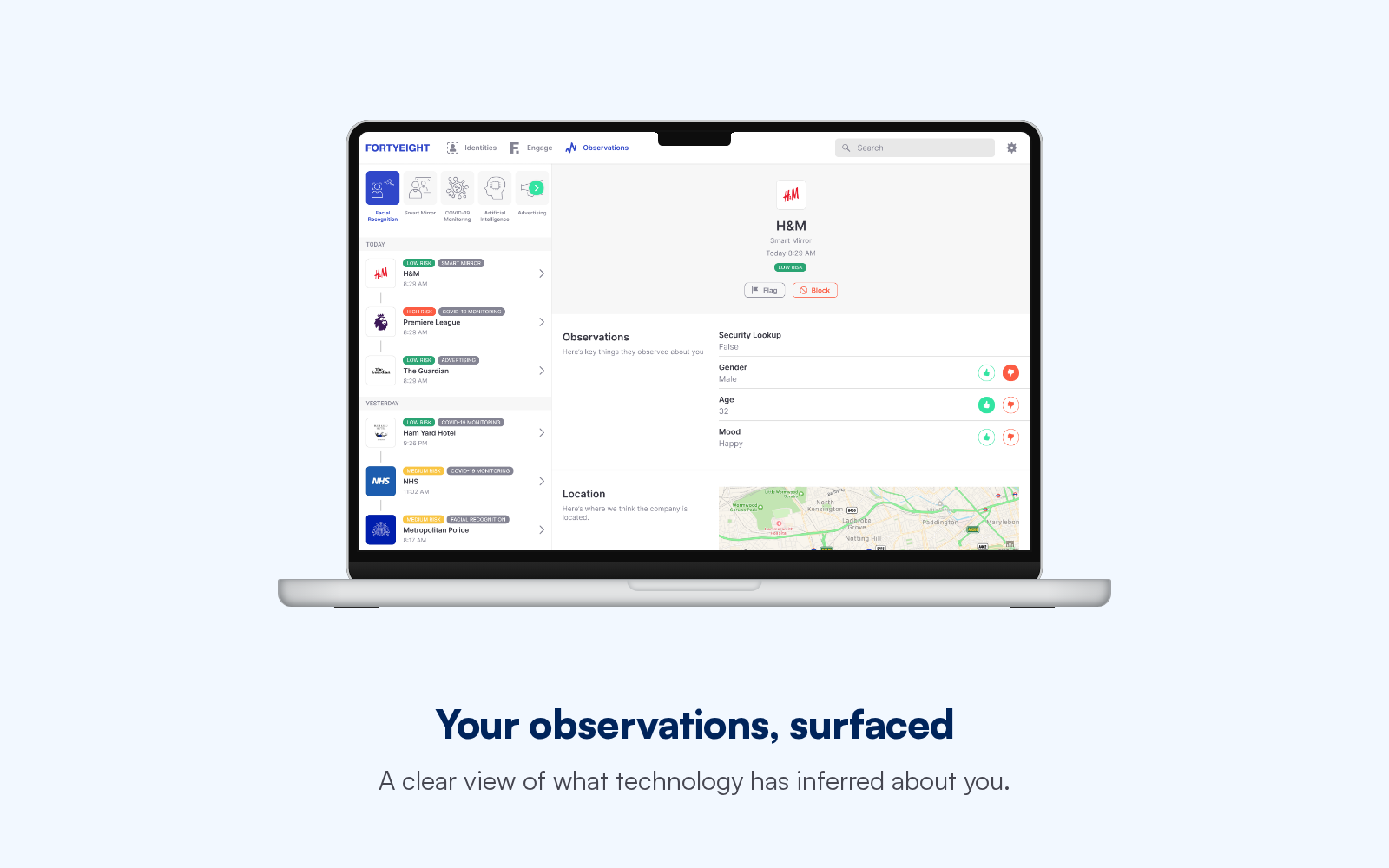
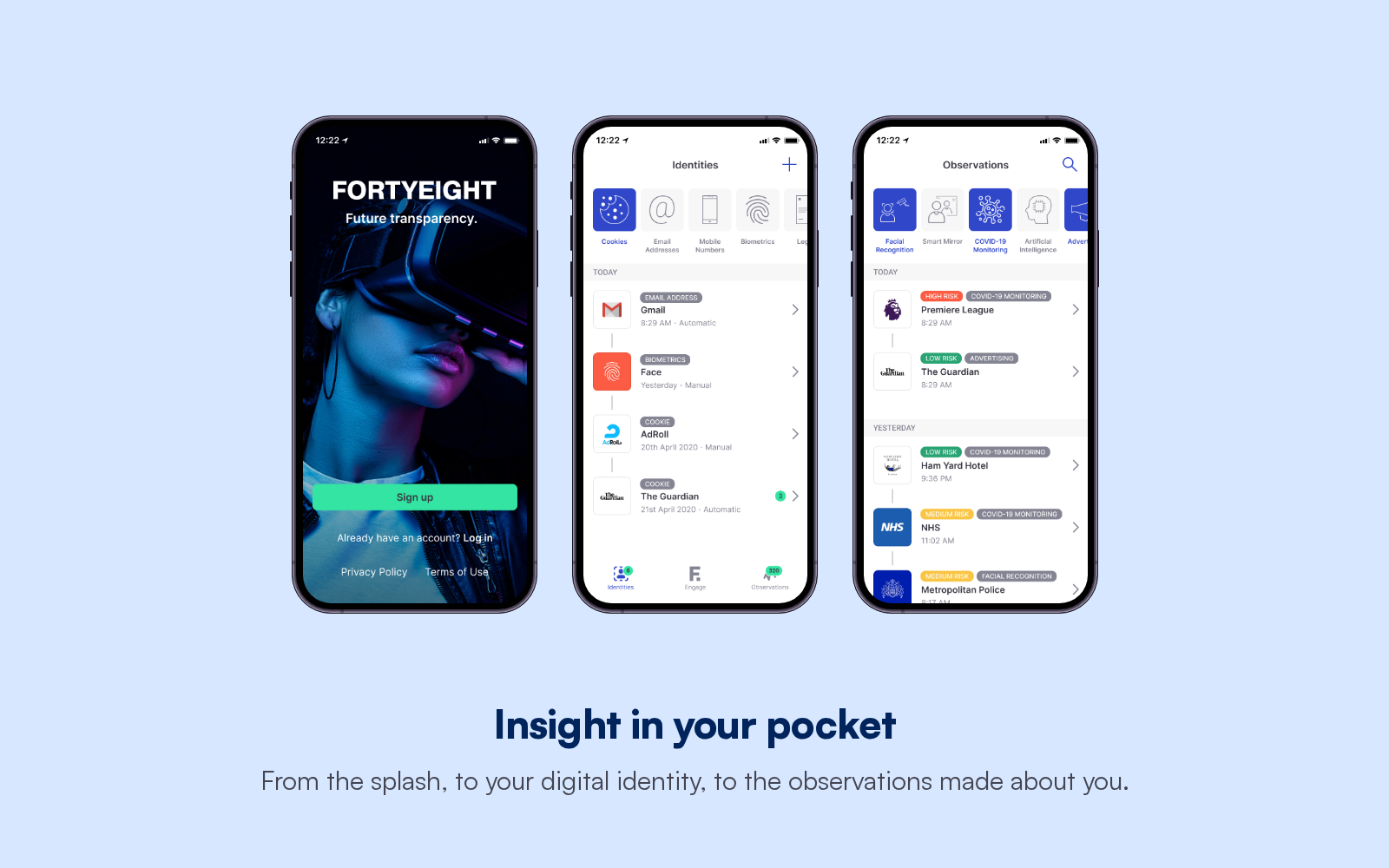
The idea sounds abstract until you see what it actually did, so here's the plain version. A company's technology makes an observation about you. It tells us. We help make sure you find out - so you can see it, question it, and decide what happens next. Companies got a simple developer API to plug into; people got somewhere to see what was being said about them and push back. We built it so the two halves never touched: a company's raw guesses only reached a person once that person's identity had been confirmed independently, so FORTYEIGHT.ai itself could never quietly become the thing it was built to hold to account.
It wasn't a slide deck. It was a working product, with a real developer flow and a real consumer experience. And around it we built a small family of things, each one a different way of making the idea real. C19Safety.co was a privacy-first venue check-in we built for the pandemic in about a month; it grew into a genuine revenue line and the route through which we did our work with Formula 1. Dawn.chat explored what the same thinking felt like as a friendly consumer product. And the FORTYEIGHT Observer turned the whole idea back on you: a browser extension that watched your own browsing and showed you what the big platforms could quietly work out about you, in about thirty seconds. (C19Safety.co and Dawn.chat have their own stories elsewhere.)
Six months, and some remarkable company
We started building in April 2020. By that October we'd shipped the product, won grant funding from Innovate UK, brought in a brilliant co-founder in Yves Weissig as CTO, taken our first revenue, and scaled to dozens of live venues and past twenty thousand real notifications to real people. Six months, start to scale.
In the same half-year, two extraordinary partners came on board. Twilio, the communications infrastructure quietly powering a huge slice of the internet, backed us with their platform, which is how the venue check-in could reach people over SMS, WhatsApp and web without anyone needing to download a thing. And in the September, Formula 1 came to us about putting FORTYEIGHT.ai to commercial use. For a company barely two quarters old to be trusted by names of that size still makes me grin. Alongside them, Innovate UK funded us across two rounds, angel investors backed the pre-seed, and Virgin picked us for its Collective Impact programme, which had us sharing a room with the likes of Holly Branson barely a year in. When that many serious people lean in that early, it tends to mean you're onto something.
I co-founded FORTYEIGHT.ai with Yves, who ran the technology while I led the product and the case for it - the idea itself, the consumer experience, the developer API, the writing, the advocacy, and the funding that kept the lights on. Giles Palmer and Amir Klaus backed and advised us early, which at that stage is worth more than I can easily say.
On hold, but a long way from over
FORTYEIGHT.ai is shelved today, and I'll be straight about why, because it isn't the usual story. Taking on the establishment needs a particular kind of fire, and people.io had already shown me, over four years, exactly how much it asks of you. FORTYEIGHT.ai was going to need every bit as much. Then, within three months, I lost my dad and my closest friend, and the fire a fight like this demands just wasn't there. Pretending otherwise wouldn't have been fair to the idea, or to the people who'd backed it, so I made the call to set it down rather than half-fight for something I believed in completely.
The idea, though, I've kept. Everything FORTYEIGHT.ai argued in 2020 has only grown truer: facial recognition is part of ordinary life now, and what AI quietly decides about us has gone from a fringe worry to one of the questions of the decade. The company is resting. The argument behind it isn't. And one day, when the timing and the fire line up, neither might the company be.