
A platform that let you own your personal data and license it on your own terms - and a bet that the world would soon agree this was the only sensible way round. It mostly has. We were just early.
In 2015, millions of people did something the advertising industry found horrifying: they installed ad blockers. The standard reading inside the industry was lost revenue, a problem to be engineered around. I read it differently. People weren't rejecting advertising; they were rejecting a deal they'd never agreed to: being followed, profiled and sold, invisibly, with nothing offered back. An ad blocker was the only "no" the system let them say. people.io started from a simple question: what if you could say yes instead, on your own terms, and be rewarded for it?
What the ad blockers were really saying
I'd come from the inside. Before people.io I was Global Creative Technical Director at Team Detroit, WPP's agency for Ford, so I'd spent years on the side of the industry that collects the data. The more I saw, the more the model looked both wrong and, oddly, inefficient. Companies were spending fortunes to guess at people from scraps and proxies, while the people themselves - the only ones who actually knew their own lives - got nothing and were told nothing. The conviction behind people.io was that this was backwards. Give a person genuine ownership and control of their data, reward them fairly for sharing it, and they'll give you richer, truer signals than any amount of covert collection. Better for them, better for the companies, and honest for once. The reframe I kept coming back to wasn't "what is your data worth?" It was the more uncomfortable question: what is the cost of not controlling it?
A firewall for people
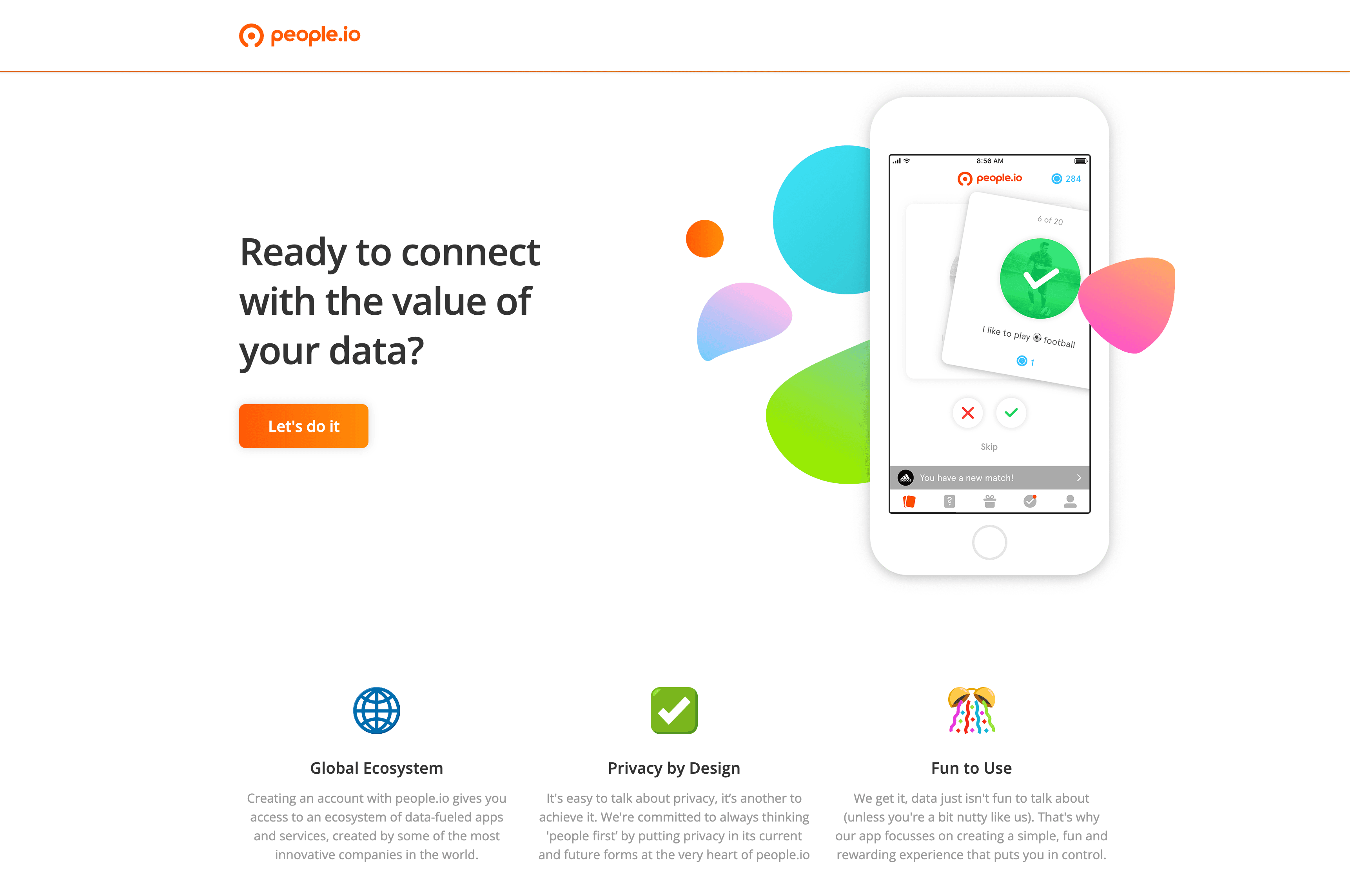
So we built what I described at the time as a firewall for people. An app, aimed at 18-to-25-year-olds, that let you connect the accounts you already had, Gmail and Spotify and the like, and answer quick, swipe-style questions about yourself, the way you'd swipe on a dating app. In return you earned real rewards: gift cards, subscriptions, donations to causes you cared about. Every time your data was used, you saw it happen and you'd agreed to it first. Nothing leaked out the back.
The clever part sat underneath. Rather than handing your raw data to advertisers, the platform built a private, living model of your preferences and let brands reach the right person without ever seeing that person's actual data, with a consent layer in the middle enforcing what you had and hadn't allowed. In plain terms: companies got to talk to exactly the people they wanted, and you never had to hand over your diary to make it happen. The rewards weren't a gimmick, either. They solved the hardest problem in any data product, which is that good personalisation needs a lot of data up front. Paying people fairly was how you earned that depth honestly, instead of taking it.
What happens when you actually ask people
It turned out people rather liked being asked. Our 2016 East London beta reached 150,000 users in under six months, who answered more than 120 million questions between them. The numbers that made investors lean in were the ones underneath: 64% of users came back on day three, around four times the going rate for consumer apps at the time, and a quarter were still active after four months. When we ran brand campaigns, for ASOS, lastminute.com, Wahaca, even a Derren Brown tour, opted-in audiences behaved like nothing the advertisers were used to: click-through rates as high as 36%, video completion north of 95%. That is what consent looks like when you do it properly. It doesn't suppress engagement; it is the engagement.
In July 2017 we hit number one trending on the UK App Store. Earlier that year, in January, I'd stood in Times Square and rung the Nasdaq closing bell after they'd named us a Rising Star: a slightly surreal moment for a company arguing that the data economy had its incentives upside down. Marketing Week put us in their hundred most disruptive brands. The press, from the FT to the BBC to TechCrunch, kept circling the same question we'd built the whole company around: should we really be giving this away for free?
24 million customers, in the strictest market in Europe
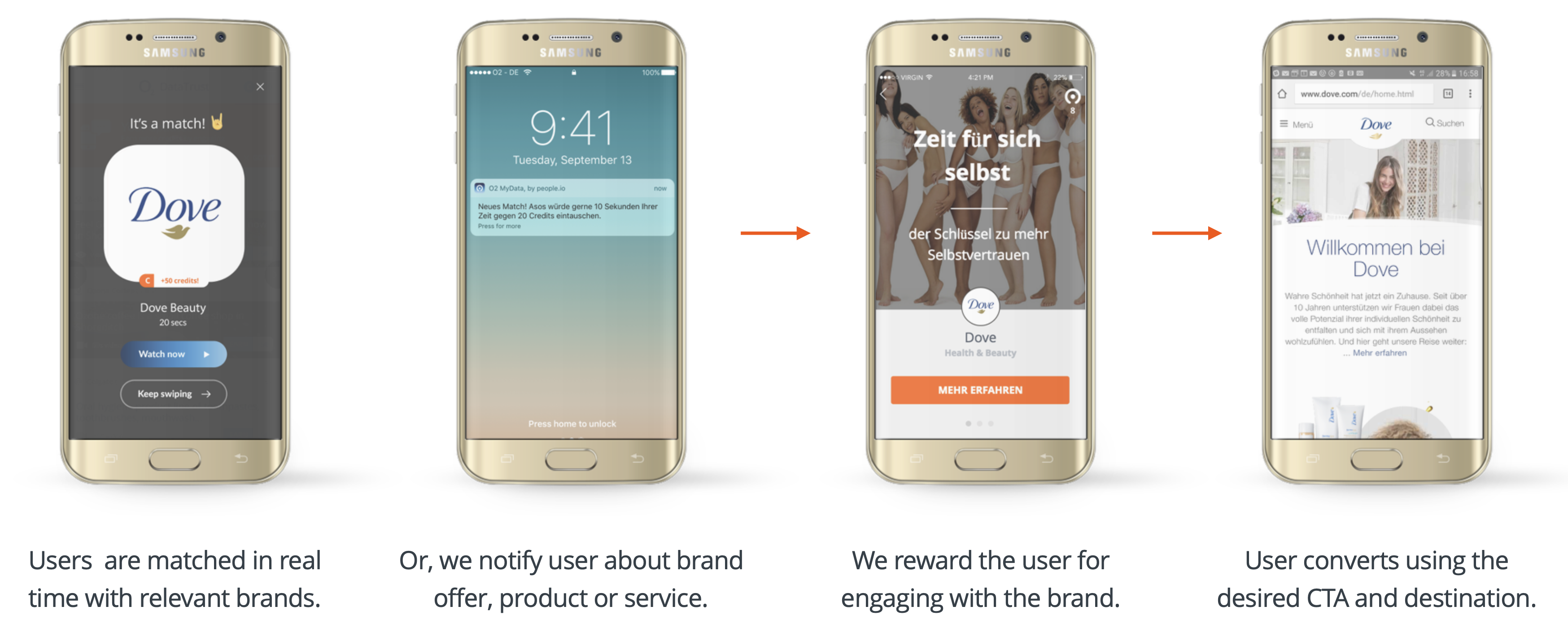
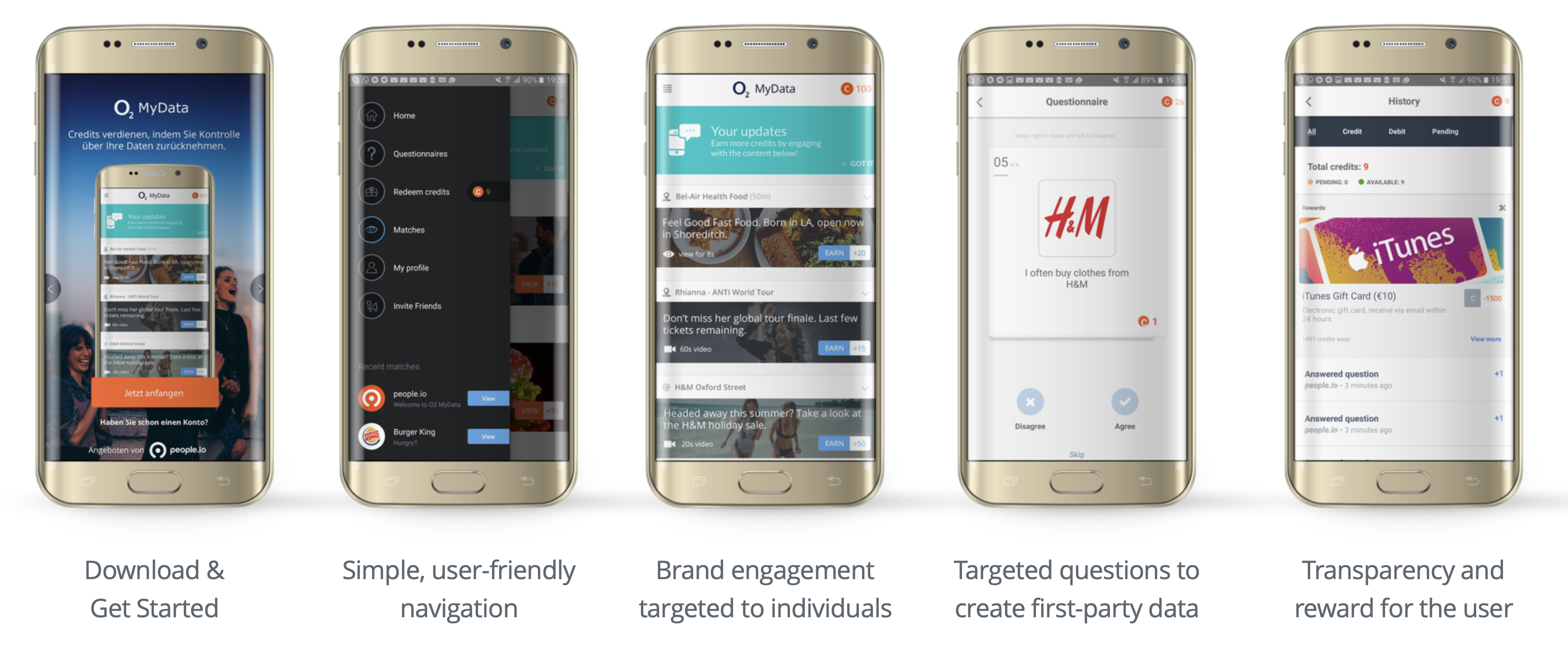
The hardest proof to win was also the most convincing. In 2017 we partnered with Telefónica to launch O2 GET in Germany: our platform, co-branded by one of Europe's largest operators, offered to roughly 24 million customers. Germany is about the most demanding privacy market on earth, which was precisely the point: if consent-first data could work there, compliantly, at that scale, the model wasn't a London curiosity. It was infrastructure. We'd been taken through Founders Factory and Telefónica's own accelerator, Wayra, and backed along the way by people who'd built real things (Thomas Höegh, ASOS founder Nick Robertson, Brent Hoberman), raising more than £2.6m to chase it down.
Right idea, wrong year
And then we didn't make it. people.io wound down in 2019. I'm not going to dress that up: we ran out of road. The honest diagnosis is timing, not concept. Our whole business depended on convincing companies inside a £16bn advertising machine, one built end to end on silent extraction, to pay for consented, honest access instead. GDPR arrived in 2018 and validated every principle we'd been shouting about, but regulation changes the law faster than it changes corporate habit, and the gap between the two was wider than our runway. We could have closed it by quietly compromising the consent model. We decided, more than once, that we'd rather not, and turned down deals that would have required it. That choice probably cost us the company. I'd still make it again.
Everything we said out loud in 2016
Nearly everything people.io warned about has since walked onto the main stage: that systems could infer the most intimate things about you from "anonymous" data; that consent forms couldn't keep pace with machines that understand you better than you understand yourself; that the value people create with their data was being decoupled from the people themselves. We pointed at the DeepMind/NHS data deal as the shape of things to come, and got odd looks. It is now a standard case study in AI ethics. In an economy where AI runs on human data, the question of who owns that data, and who shares in its value, has gone from fringe to unavoidable.
people.io was a bet that ownership, transparency and consent would turn out to be the foundation of how technology gets built, not a constraint on it. That bet was early. I don't think it was wrong, and it's the same conviction I build from at NO Product today.
