
A WhatsApp bot that turns voice notes you can't face into a quick text summary, in 99+ languages, with a dry British attitude.
The voice note you can't face
I built this one for myself, mostly. The problem is petty and completely universal: a friend sends you a rambling ten-minute voice note about something that needed one sentence of text, and you have neither the time nor the will to sit through it. The official tagline is "flipping the bird to voice notes", which tells you roughly how seriously the whole thing takes itself, and where the half-bleeped "f-" comes from. It lives entirely inside WhatsApp. There's no app to install and nothing to sign up for. You forward a voice note to the number and it deals with it. Under thirty minutes a month, it's free.
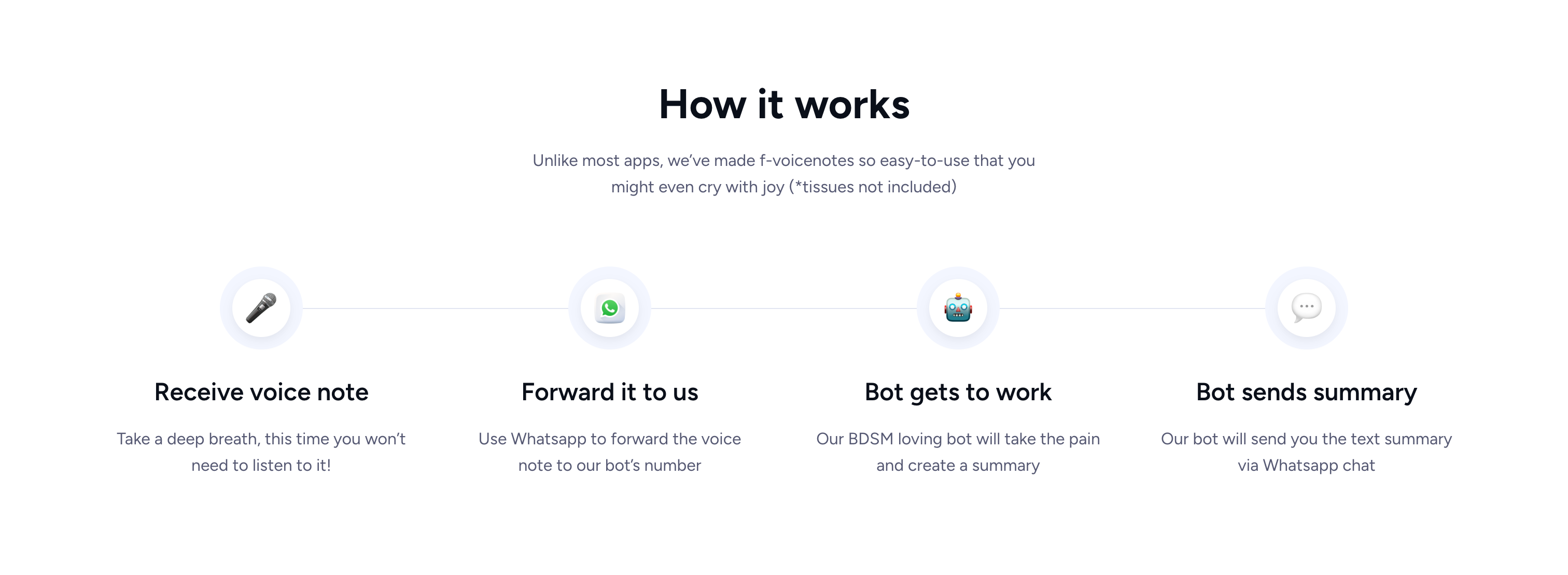
Forward it, then forget it
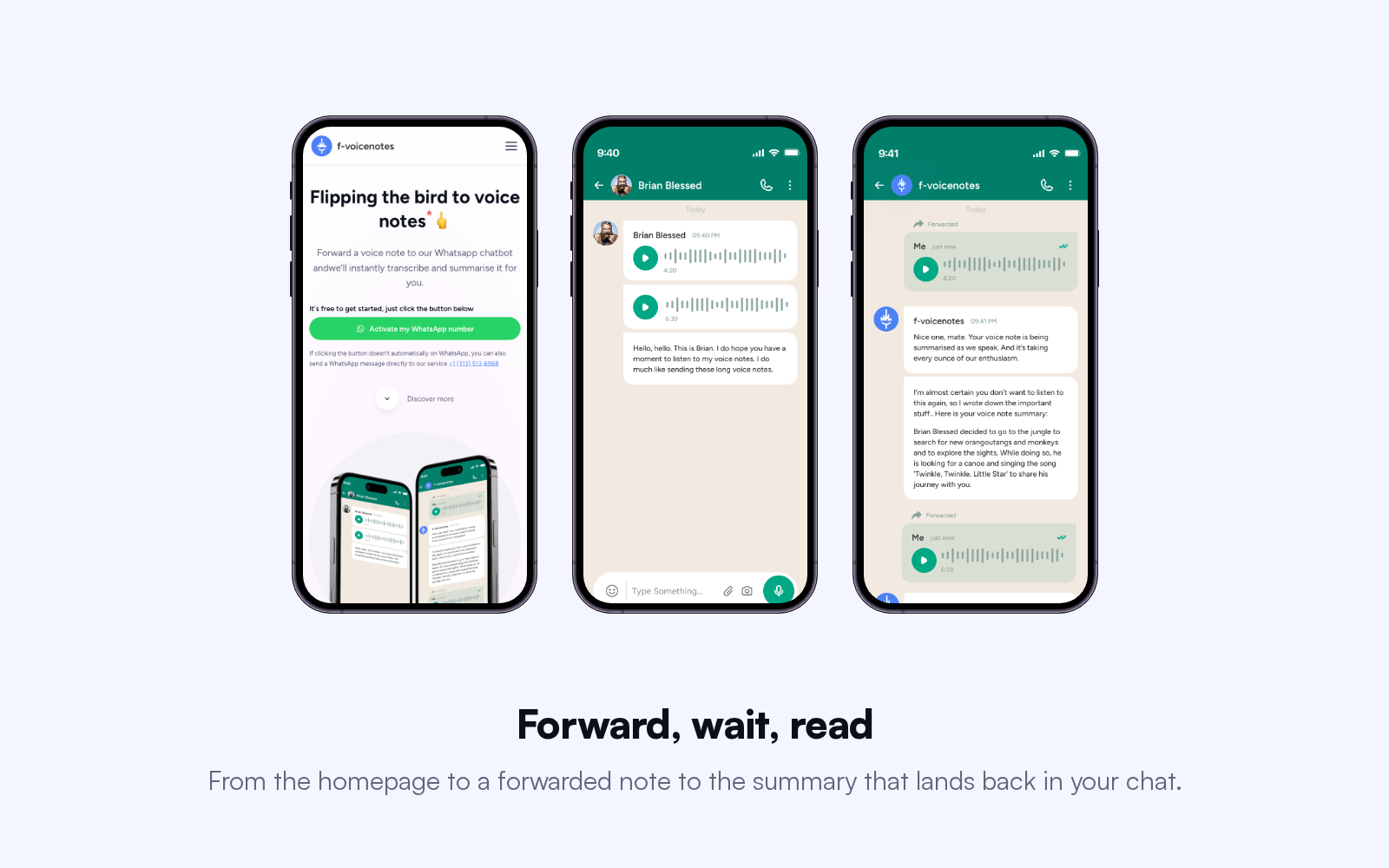
Forward a voice note and three things happen. Within about a second the bot drops a 🤖 reaction onto your message so you know it's listening. A beat later it fires back a sarcastic "got it". Then, in roughly thirty seconds, the transcription and a short summary arrive as text.
The personality is deliberate, and it's the part people remember. The house style is "sarcastic, British, useful - in that order". One detail I'm pleased with: the summaries try to hold onto the speaker's tone rather than flatten it. A voice note from a mate having a laugh shouldn't come back reading like the minutes of a board meeting. And it never opens with "the speaker says", because you already know who's speaking. You're the one who couldn't be bothered to listen.
The two uses I never saw coming
I built it for me and my friends. Several thousand people ended up using it.
Two of those uses stuck with me. The first I found myself: as someone who travels constantly, the most valuable thing the bot does isn't summarising my friends, it's translation. A local sends you a voice note in a language you don't speak, full of slang and colloquialisms, fast, with background noise you'd never untangle by ear, and it comes back as clean text you can actually read. That alone made day-to-day life abroad dramatically easier, and a lot of users told me the same.
The second I'd never have predicted. A friend in Mexico messaged me to say a deaf colleague of his was using the service as an accessibility tool at work, and asked whether we could lift the usage cap for them. That a daft side-project with a rude name had become something genuinely useful to someone is still my favourite thing about it.
Three rebuilds, and the case for not charging
f-voicenotes.com has been rebuilt three times, and most of the lessons came before any of the recent AI tooling existed. The first versions were a proper product-management exercise: scoping, prototyping, wiring together open-source libraries, and learning a pile of good and bad lessons the slow way. The early bot rode an unofficial WhatsApp library, which meant I spent real time talking to people on WhatsApp's own engineering side; they shared early detail on native iPhone transcription that was coming. That feature exists now, and honestly, it still isn't as good as what this does. When the unofficial library was discontinued, the whole thing had to migrate onto Meta's official API. The most recent rebuild is a clean, ground-up version where I leaned heavily on AI as the developer, with adversarial review between stages and me as the only merge gate - but that's the latest chapter, not the whole story.
The most useful lesson was a commercial one. With thousands of users and almost no running cost, monetising looked obvious, and plenty of people told me to. So I actually ran the numbers, properly. Once you factor in cost of acquisition, retention, the time to build and maintain a billing layer, the legal upkeep, and the brand work to support a paid product, it stopped making sense. On top of that, operating systems and devices will almost certainly do this natively before long. So I made the deliberate call not to. The billing tiers, bolt-on minute packs, and the whole management system are all built and sitting there. I just never switched them on.
If anything ever takes the bot offline, it's Meta. The pipeline itself is solid. What isn't is keeping a valid Meta system-user access token alive: the rules change constantly, and generating a permanent token while living out of a suitcase has turned out to be the single most maddening part of running the thing.
Where it stands today
Live, in beta, at f-voicenotes.com. Free under thirty minutes a month. Still mostly me and my friends in spirit, even though several thousand people have used it. Built with Nour Nasser on engineering and Dmytro Stefanishyn on design.