
Most founders update their investors the hard way. Fual.io was my attempt to make it the easy thing instead - and to turn a roomful of busy backers into a network you could actually call on.
The problem I had at people.io
This one came straight out of running people.io. By 2016 we'd taken on a sizeable group of investors, and every one of them was worth far more than the cheque they'd written: between them they had the networks, the introductions and the hard-won judgement that can genuinely move a young company along. The problem was reaching them. One wanted a weekly email, another a monthly PDF, a few preferred WhatsApp, some wanted a call. Keeping that many people meaningfully in the loop, in the format each of them liked, was a real and constant drain, and the moment it slipped, all that latent help went quiet with it.
The trap is a familiar one for founders. Update your investors too little and you lose access to everything they could do for you beyond the money. Update them too much, in too many places, and you give yourself a second job and them a case of update fatigue. I wanted to close that gap without it costing me an afternoon a week.
Meeting founders where they already talk
The insight the whole thing turned on was simple: founders are already writing updates. They post them in Slack every day - what shipped, what broke, who joined, what the numbers did. The work already exists; it's just trapped inside the company. So rather than ask founders to write yet another report for investors, Fual.io let them pipe the updates they were posting anyway out to the people who wanted to follow along.
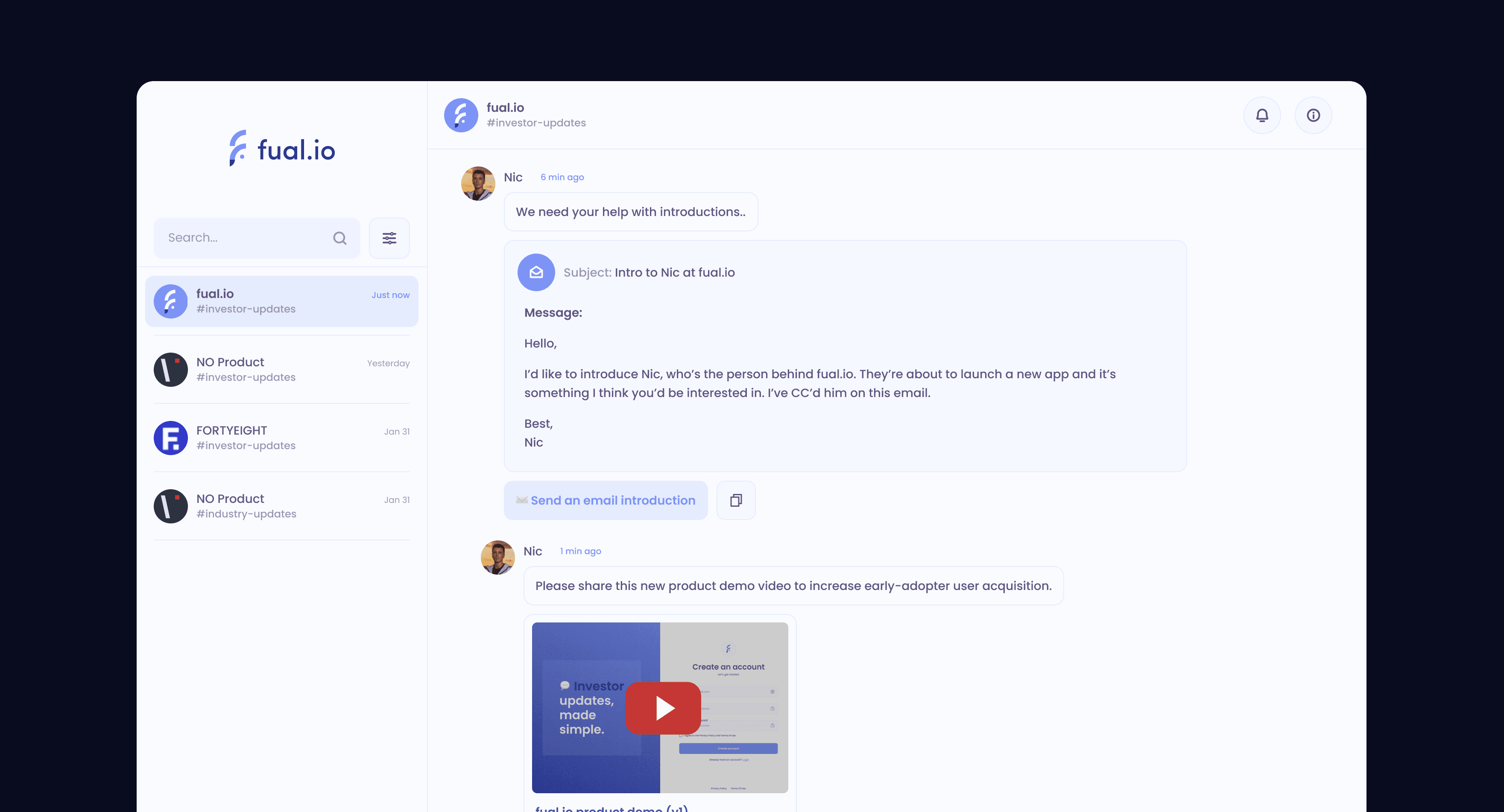
A company connected its Slack, chose exactly which channels to share, and that was more or less the end of their effort. On the other side, each investor got a single, real-time, chat-style feed of every company they backed, all in one place, without ever having to join anyone's Slack. No more scattered threads, no more chasing. And because it knew who was reading, it could do the genuinely useful bit: a founder could fire off an "action" (a request for an introduction, or a share of a launch) and an investor could help with a single tap. The name is a play on fuel: the point was to turn that goodwill into momentum.
Two builds, six years apart
I'll be honest about the shape of this one, because it's an unusually long story for a product this size. The first version, back in 2017, was built by Sid Ferreira as a Slack-archiving tool with a companion mobile app. It worked, but it never quite found its moment, and it sat dormant for a long stretch while I was deep in other things.
What brought it back was conviction rather than momentum. In late 2022 I replatformed it from the ground up with Nourz1234 doing the heavy engineering: a proper Flask web app, a real two-sided model with separate front doors for companies and investors, the lot. This was the version that finally matched the idea in my head. It reached a genuinely production-grade state through 2023: real-time sync, encrypted at rest, the works.
Why it's resting
And then I let it rest. Fual.io is dormant now, and the reason is the honest one: it's a hard product to make a business of. It only works when founders post consistently, and "tools that depend on a busy founder forming a new habit" is one of the trickier categories there is. The value was real, the build was solid, but I had louder fires to fight and chose not to push it up the hill alone.
I still think the core idea is right, and quietly under-served: that the best thing you can do with an investor base isn't to report at them, but to keep them close enough, with little enough friction, that their networks stay switched on. Most founders are still doing that the hard way. One day the tool that fixes it properly will do very well.